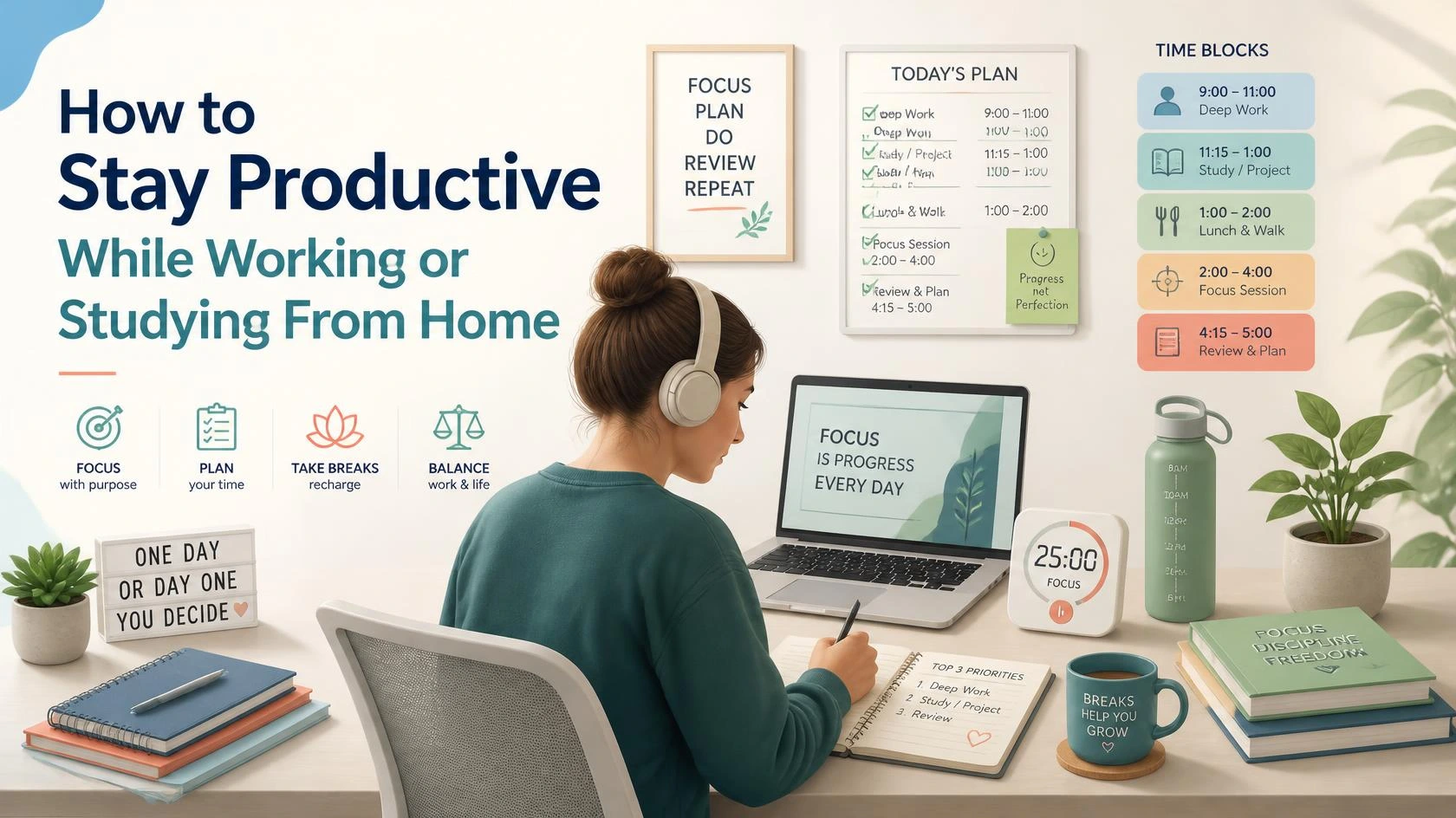
Learn practical ways to stay productive while working or studying from home. Discover tips for managing time, reducing distractions, improving focus, and building a productive daily routine.
How to Stay Productive While Working or Studying From Home: A Complete Guide
Working or studying from home offers many benefits. You may save time on commuting, have more flexibility, and create a schedule that fits your lifestyle. However, staying productive at home can also be challenging.
At home, there are often more distractions, fewer structured routines, and less separation between work, study, and personal life. A comfortable environment can sometimes make it difficult to stay focused.
You may begin the day with good intentions but find yourself checking your phone, browsing social media, watching videos, doing household tasks, or switching between unrelated activities.
The good news is that productivity at home does not depend on working continuously for long hours. Instead, it depends on creating a system that helps you focus on important tasks, manage distractions, and maintain a realistic routine.
This guide explains practical strategies to help you stay productive while working or studying from home.
Why Is It Difficult to Stay Productive at Home?
A traditional workplace or classroom naturally provides structure.
You may have:
- A fixed starting time.
- A specific location for work or study.
- Teachers, managers, or colleagues around you.
- Scheduled breaks.
- Clear expectations.
At home, much of that structure disappears.
You become responsible for deciding:
- When to start.
- What to work on.
- How long to focus.
- When to take breaks.
- How to manage distractions.
This freedom can be beneficial, but it also requires self-management.
The goal is not to recreate an office or classroom exactly. Instead, create enough structure to help you complete your responsibilities effectively.
Start With a Clear Plan for the Day
One of the easiest ways to improve productivity is to know what you need to do before you begin.
Starting the day without a plan can lead to wasted time.
You may move between emails, messages, websites, and small tasks without completing anything important.
Instead, create a simple daily plan.
Choose Your Most Important Tasks
Ask yourself:
What are the three most important things I need to complete today?
These tasks should receive your attention before less important activities.
For example, if you are working from home, your priorities might include:
- Complete a client project.
- Prepare a report.
- Attend an important meeting.
If you are studying, they might include:
- Complete a chapter.
- Review class notes.
- Practice questions.
A short and realistic list is usually more useful than an extremely long to-do list.
Create a Dedicated Work or Study Space
Your environment can influence your ability to focus.
You do not necessarily need a separate office.
Even a small, consistent area can help create a mental connection between that location and focused work.
Your workspace should ideally have:
- A comfortable chair.
- Enough lighting.
- A stable surface.
- The tools you need.
- Minimal distractions.
Try to avoid working from your bed whenever possible.
Your bed is associated with rest and sleep. Using it regularly for work or studying can make it harder to separate different parts of your day.
If space is limited, create a simple routine of setting up and packing away your work materials.
This can help create a clearer beginning and end to your work or study period.
Set a Consistent Starting Time
You do not need to wake up at the same time every day to be productive, but having a relatively consistent routine can make it easier to get started.
For example:
- Wake up.
- Get ready for the day.
- Have breakfast.
- Review your tasks.
- Begin your first important activity.
The important part is creating a transition into work or study mode.
Without a clear starting point, it can be easy to delay important tasks.
You might tell yourself:
“I’ll start in 10 minutes.”
Then 10 minutes becomes an hour.
A simple routine reduces the number of decisions you need to make.
Use Time Blocks to Structure Your Day
Time blocking is a simple method of assigning specific periods to specific activities.
For example:
| Time | Activity |
|---|---|
| 9:00–10:30 AM | Focused work or study |
| 10:30–10:45 AM | Short break |
| 10:45 AM–12:00 PM | Second priority task |
| 12:00–1:00 PM | Lunch and rest |
| 1:00–2:30 PM | Meetings, research, or assignments |
| 2:30–2:45 PM | Short break |
| 2:45–4:00 PM | Remaining important tasks |
You do not need to follow the schedule perfectly.
The purpose is to create direction.
A time-blocked schedule can help prevent the entire day from becoming a collection of unplanned activities.
Focus on One Task at a Time
Multitasking often feels productive because you are doing several things at once.
However, constantly switching between tasks can make it harder to complete important work.
For example, you may be:
- Writing an assignment.
- Checking messages.
- Responding to email.
- Watching a video.
- Browsing social media.
Although you are active, your attention is divided.
Try choosing one task and giving it your full attention for a specific period.
You can use a simple approach:
Step 1: Choose One Task
For example:
“Complete the introduction to my assignment.”
Step 2: Remove Unnecessary Distractions
Close unrelated tabs and applications.
Step 3: Set a Focus Period
Work for 25, 45, or 60 minutes.
Step 4: Take a Short Break
Stand up, stretch, drink water, or rest.
Then continue with the next focused session.
Manage Your Phone and Notifications
Your smartphone can be useful for work and study, but it can also become one of the biggest distractions.
A single notification can interrupt your concentration.
Even if you only check your phone for a few seconds, it can take time to return to your original task.
Consider:
- Turning off unnecessary notifications.
- Keeping your phone away from your desk during focused work.
- Using Do Not Disturb mode.
- Checking messages during planned breaks.
You do not have to ignore important calls or messages.
The goal is to reduce interruptions that do not require immediate attention.
Use the Pomodoro Method or a Similar Focus System
The Pomodoro Technique is a popular productivity method.
A traditional version involves:
- Working for 25 minutes.
- Taking a 5-minute break.
- Repeating the cycle.
- Taking a longer break after several sessions.
However, you do not need to follow these exact numbers.
Some people prefer:
- 45 minutes of work and 10 minutes of rest.
- 60 minutes of work and 15 minutes of rest.
- 90 minutes of focused work followed by a longer break.
Experiment and find a system that suits the type of work you do.
Break Large Tasks Into Smaller Steps
Large tasks can feel overwhelming.
For example:
“Write a 3,000-word report.”
This may seem difficult to begin.
Instead, break the task into smaller steps:
- Research the topic.
- Create an outline.
- Write the introduction.
- Complete the first section.
- Complete the second section.
- Review and edit the content.
Smaller tasks are easier to start.
This approach can also help you see progress throughout the day.
Identify Your Biggest Distractions
Everyone has different distractions.
For some people, it may be social media.
For others, it may be:
- Television.
- Household responsibilities.
- Gaming.
- Messages.
- Online shopping.
- News websites.
- Conversations.
Pay attention to what regularly interrupts your work or study sessions.
Once you identify the distraction, you can create a solution.
For example:
Problem: Constantly checking social media.
Possible solution: Log out during focused work or keep the app away from your home screen.
Problem: Too much noise.
Possible solution: Use headphones, work during quieter hours, or choose a different location.
Problem: Household tasks interrupt study time.
Possible solution: Create a specific time for household responsibilities instead of switching between them constantly.
Take Regular Breaks
Productivity does not mean working without stopping.
Long periods of continuous work can lead to fatigue and reduced concentration.
Short breaks can help you return to your tasks with more focus.
During a break, try to do something different from your work.
For example:
- Walk around.
- Stretch.
- Drink water.
- Have a healthy snack.
- Look away from your screen.
- Get some fresh air.
Try to avoid turning every short break into another long scrolling session.
A five-minute break can easily become 30 minutes if you open a highly engaging app.
Avoid Creating an Unrealistic Schedule
A common productivity mistake is planning more than you can realistically complete.
You may create a list containing:
- Eight hours of work.
- Three hours of studying.
- Exercise.
- Household tasks.
- Reading.
- Learning a new skill.
While ambition can be useful, an unrealistic schedule can create frustration.
Instead, estimate how long tasks will actually take.
Leave space for:
- Unexpected problems.
- Breaks.
- Meals.
- Personal responsibilities.
A realistic plan is more sustainable than an impossible one.
Separate Work, Study, and Personal Time
When you work or study from home, the boundaries between different parts of life can become unclear.
You may answer work messages during dinner or think about assignments late at night.
Creating boundaries can help.
For example, when you finish your work or study session:
- Close your laptop.
- Put away your materials.
- Log out of work-related accounts when appropriate.
- Write down tomorrow’s priorities.
This creates a signal that the main work period has ended.
Similarly, when it is time to work, try to avoid mixing too many personal activities into your focused sessions.
Start With the Most Important Task
Many people begin their day by checking:
- Email.
- Social media.
- Messages.
- News.
- Notifications.
These activities can consume a large amount of time before meaningful work begins.
Consider completing one important task first.
This does not mean you should ignore urgent responsibilities.
Instead, avoid allowing low-priority activities to control your entire morning.
Completing an important task early can also create momentum for the rest of the day.
Use a Simple Task Management System
You do not need a complicated productivity system.
A notebook, calendar, or simple task management app may be enough.
Try organizing tasks into categories:
Must Do
Tasks that are important and time-sensitive.
Should Do
Important tasks that should be completed soon.
Could Do
Tasks that would be useful but are not urgent.
This can help you avoid spending your best energy on low-priority activities.
Learn When You Are Most Productive
Different people have different periods of high concentration.
Some people focus best in the morning.
Others work better in the afternoon or evening.
Pay attention to when you feel most alert.
Try scheduling your most difficult work during your strongest period.
For example:
If you focus best between 9:00 AM and 12:00 PM, use that time for:
- Writing.
- Studying.
- Problem-solving.
- Research.
- Important projects.
Use lower-energy periods for simpler activities such as:
- Organizing files.
- Responding to routine messages.
- Planning.
- Administrative tasks.
Avoid Perfectionism
Sometimes people delay completing a task because they want it to be perfect.
This can lead to procrastination.
For example, you may spend an hour preparing to start an assignment instead of actually writing it.
A better approach is to focus on progress.
Your first attempt does not need to be perfect.
You can:
- Create a rough draft.
- Review your work.
- Make improvements.
- Complete the final version.
Starting is often the hardest part.
Create Accountability
Working or studying alone can sometimes make it easier to delay tasks.
Accountability can help.
You might:
- Share your goals with a friend.
- Study with another person online.
- Join a virtual focus session.
- Report your progress to a colleague.
- Set a deadline for yourself.
Even a simple message such as:
“I will finish this task by 3 PM.”
can create additional motivation.
Keep Your Workspace Organized
A cluttered environment can make it harder to focus.
At the end of your work or study session, spend a few minutes organizing your space.
You can:
- Put documents in the correct place.
- Remove unnecessary items.
- Prepare materials for the next day.
- Close unused applications.
- Organize important files.
A clean workspace can make it easier to begin the next session.
Take Care of Your Basic Needs
Productivity is not only about time management.
Your ability to focus can also be influenced by basic factors such as:
- Sleep.
- Food.
- Hydration.
- Physical activity.
- Rest.
If you are constantly tired, hungry, or uncomfortable, productivity strategies may have limited results.
Try to build a routine that supports your ability to concentrate.
This does not require a perfect lifestyle.
Small improvements can make a difference.
What to Do When You Cannot Focus
Everyone has unproductive days.
Instead of abandoning the entire day, reduce the difficulty of getting started.
Try the five-minute method.
Tell yourself:
“I only need to work on this for five minutes.”
Open the document.
Read the notes.
Write one paragraph.
Review one page.
Often, starting creates momentum.
If you still cannot focus, take a proper break and return later.
Do not assume that one unproductive hour means the entire day is lost.
A Sample Productive Day at Home
Here is a simple example:
Morning
- Wake up and get ready.
- Avoid unnecessary social media.
- Review your priorities.
- Complete your most important task.
Midday
- Take a proper break.
- Eat and rest.
- Respond to important messages.
- Continue with secondary tasks.
Afternoon
- Attend meetings or classes.
- Complete assignments or administrative work.
- Review your progress.
Evening
- Finish remaining important tasks.
- Prepare your plan for tomorrow.
- Close work or study materials.
- Spend time on personal activities.
You can adjust this schedule according to your responsibilities.
Common Mistakes That Reduce Productivity at Home
Working Without a Plan
Without priorities, it is easy to stay busy without making meaningful progress.
Trying to Do Everything
Choose a realistic number of important tasks.
Checking Notifications Constantly
Reduce unnecessary interruptions.
Skipping Breaks
Rest can help maintain focus over a longer period.
Using Too Many Productivity Tools
Keep your system simple.
Working All Day Without Boundaries
More hours do not always mean better results.
Being Too Hard on Yourself
Not every day will be equally productive.
Focus on building sustainable habits.
Frequently Asked Questions
How can I stay productive while working from home?
Create a dedicated workspace, plan your important tasks, reduce notifications, use focused work sessions, take regular breaks, and establish clear boundaries between work and personal time.
How can students stay focused while studying at home?
Students can improve focus by creating a consistent study schedule, choosing a quiet workspace, breaking large assignments into smaller tasks, limiting phone distractions, and using regular breaks.
What is the best productivity method?
There is no single method that works for everyone. Time blocking, focused work sessions, the Pomodoro Technique, and simple task prioritization are useful approaches to experiment with.
How many hours should I work or study at home?
The right amount depends on your responsibilities and the type of work. Focus on completing meaningful tasks and maintaining regular breaks rather than measuring productivity only by the number of hours spent at a desk.
How do I stop procrastinating at home?
Start with a small step. Break large tasks into smaller actions, remove distractions, set a short focus period, and avoid waiting until you feel completely motivated before beginning.
Conclusion
Staying productive while working or studying from home requires more than motivation.
It requires a system.
Start by creating a clear plan, identifying your priorities, and setting up an environment that supports focus. Reduce unnecessary distractions, manage your phone and notifications, and work on one task at a time.
Remember that productivity is not about filling every hour with work.
A productive day is one in which you make meaningful progress on the tasks that matter.
Experiment with different routines and focus methods until you find an approach that works for your lifestyle.
Small, consistent improvements can help you build better habits and make working or studying from home more effective, organized, and sustainable.
Suggested Internal Links
You can link this article to other relevant articles on YU Team:
How to Find Reliable Information Online: A Practical Guide to Research, Verification and Online Safety
How to Build Better Digital Habits: A Practical Guide to Managing Your Time, Apps and Online Life
How to Organize Your Daily Routine for Better Productivity and Less Stress
A Complete Guide to Choosing the Right Apps and Online Tools for Everyday Life