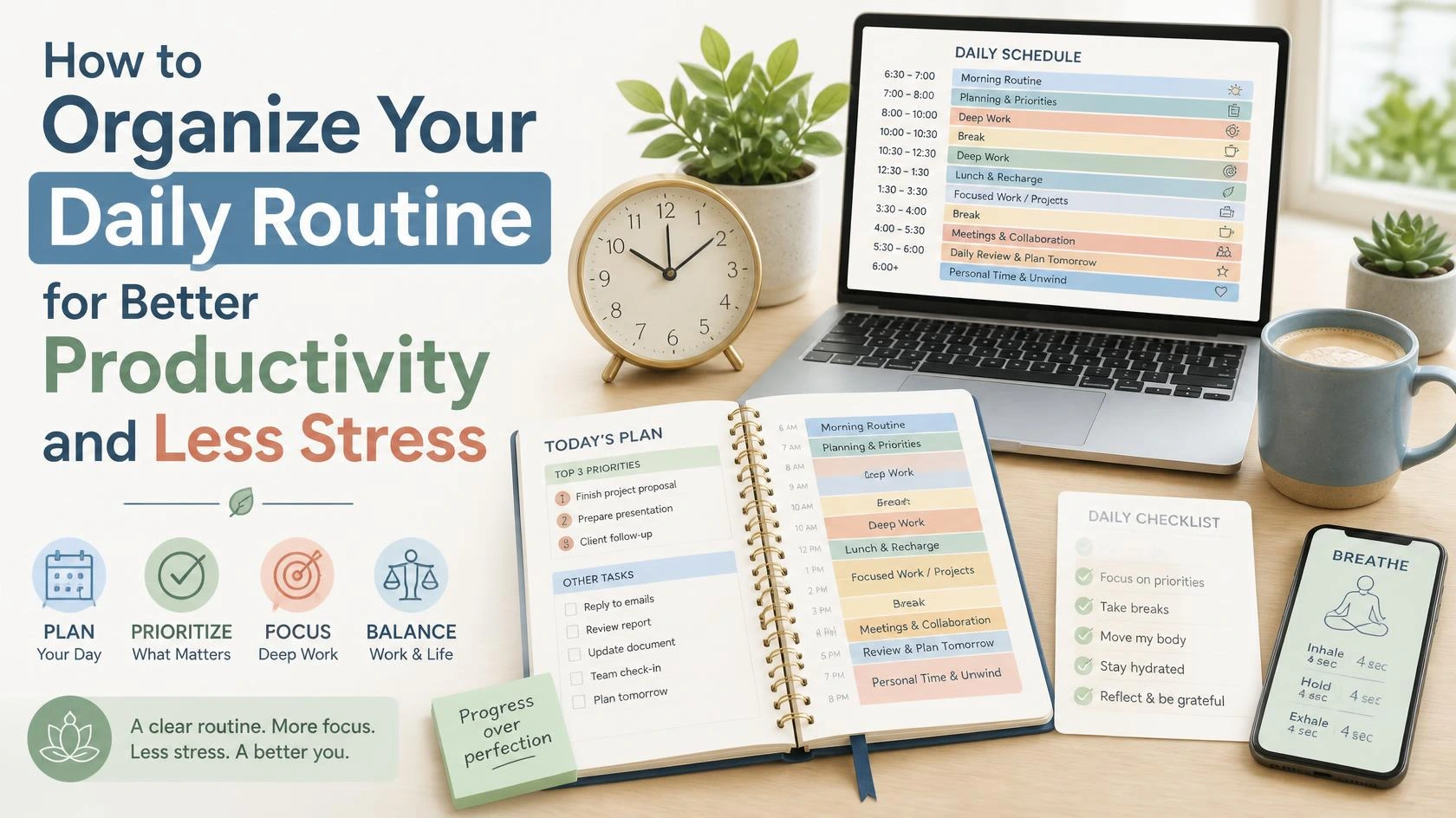
Complete guide on how to organize your daily routine with practical tips for managing time, prioritizing tasks, building healthy habits, improving productivity, and reducing unnecessary stress.
How to Organize Your Daily Routine for Better Productivity and Less Stress
A well-organized daily routine can make life feel more manageable. When you know what needs to be done and have a general structure for your day, it becomes easier to focus on important tasks and avoid unnecessary stress.
However, organizing a daily routine does not mean planning every minute.
In fact, an overly strict schedule can sometimes create more pressure. Unexpected events happen, priorities change, and some days simply do not go according to plan.
The purpose of a good daily routine is to create structure without removing flexibility.
A practical routine can help you:
- Manage your time more effectively.
- Complete important tasks.
- Reduce last-minute stress.
- Build healthier habits.
- Create better work and study routines.
- Make time for rest and personal activities.
- Avoid feeling overwhelmed by a long list of responsibilities.
Whether you work from home, study, manage a business, or have a busy personal schedule, this guide will help you create a daily routine that is realistic and easier to maintain.
What Is a Daily Routine?
A daily routine is a general structure for how you spend your day.
It may include activities such as:
- Waking up.
- Preparing for work or study.
- Completing important tasks.
- Eating meals.
- Exercising.
- Managing household responsibilities.
- Spending time with family or friends.
- Relaxing.
- Preparing for the next day.
A routine does not need to be identical every day.
Instead, it provides a framework.
For example, you may usually complete your most important work in the morning, handle smaller tasks in the afternoon, and use the evening for personal time.
The exact activities may change, but the overall structure remains useful.
Why Is a Daily Routine Important?
Without some structure, it can be easy to spend the day reacting to whatever happens.
You may begin by checking messages, then move to social media, then respond to an email, and later remember an important task that should have been completed earlier.
At the end of the day, you may feel busy but wonder what you actually accomplished.
A daily routine can help prevent this.
It gives your important activities a place in your day.
Instead of asking repeatedly:
“What should I do now?”
you already have a general idea of what deserves your attention.
This can reduce decision fatigue and make it easier to begin important tasks.
Start by Understanding Your Current Routine
Before creating a new routine, look at your current one.
For a few days, pay attention to how you spend your time.
Ask yourself:
- What time do I usually wake up?
- When do I feel most focused?
- Which activities take more time than expected?
- What regularly distracts me?
- When do I usually feel tired?
- Which tasks are most important?
- Do I have enough time for rest?
You may discover patterns that were not obvious before.
For example, you may plan to start working at 9:00 AM but regularly begin at 10:00 AM because you spend the first hour checking your phone and responding to messages.
Understanding your current routine makes it easier to create realistic improvements.
Identify Your Priorities
Not every task is equally important.
One of the biggest mistakes people make when organizing a daily routine is treating every task as urgent.
A long to-do list can make everything feel important.
Instead, divide your responsibilities into categories.
Important and Urgent
These tasks require immediate attention.
Examples include:
- Meeting a deadline.
- Preparing for an important meeting.
- Completing an urgent assignment.
Important but Not Urgent
These tasks contribute to long-term goals.
Examples include:
- Learning a new skill.
- Planning a project.
- Exercising.
- Organizing finances.
- Working on personal development.
Less Important Tasks
These may still need to be completed, but they should not take priority over more important responsibilities.
Examples include:
- Organizing unnecessary files.
- Checking non-urgent notifications.
- Repeatedly refreshing email.
- Spending too much time on minor details.
Your daily routine should protect time for what actually matters.
Do Not Try to Plan Every Minute
A detailed schedule may look productive, but it can become difficult to follow.
For example:
- 9:00–9:15: Email.
- 9:15–9:30: Planning.
- 9:30–9:45: Research.
- 9:45–10:00: Phone calls.
If one task takes longer than expected, the entire schedule can collapse.
A better approach is to use flexible time blocks.
For example:
Morning
Focused work or study.
Afternoon
Meetings, assignments, communication, or secondary tasks.
Evening
Personal responsibilities, relaxation, and preparation for the next day.
This provides structure while allowing flexibility.
Create a Simple Morning Routine
The beginning of your day can influence how the rest of it feels.
You do not need a complicated two-hour morning routine.
A simple routine may include:
- Wake up.
- Get ready for the day.
- Eat breakfast or have a drink.
- Review your priorities.
- Begin your first important task.
Try to avoid starting the day by immediately reacting to notifications.
Checking messages can sometimes be necessary, but spending the first hour scrolling through unrelated content can make it harder to begin meaningful work.
A clear morning routine creates a transition into the day.
Plan Your Most Important Task
One useful strategy is to identify your most important task before the day becomes busy.
Ask:
“If I complete only one important thing today, what should it be?”
This might be:
- Completing an assignment.
- Finishing a work project.
- Preparing a presentation.
- Studying for an exam.
- Making progress on a personal goal.
Try to schedule this task during a period when you are usually able to focus.
For many people, this may be in the morning, but everyone is different.
The important thing is to avoid spending your best hours only on low-priority activities.
Use a Daily Planning System
Your planning system does not need to be complicated.
You can use:
- A notebook.
- A calendar.
- A task management app.
- A simple document.
The tool is less important than the habit of planning.
At the beginning or end of each day, write down:
Top Priorities
Choose two or three important tasks.
Secondary Tasks
Include smaller responsibilities that can be completed when time is available.
Appointments and Deadlines
Add meetings, classes, appointments, and important deadlines.
This creates a clear overview of your day.
Example of a Simple Daily Routine
Here is an example of a flexible routine:
| Part of Day | Suggested Activity |
|---|---|
| Morning | Wake up, prepare for the day, review priorities |
| Early work period | Complete the most important task |
| Midday | Break, meal, messages, and smaller responsibilities |
| Afternoon | Meetings, study, secondary tasks, or project work |
| Evening | Personal activities, family time, exercise, or relaxation |
| End of day | Review progress and prepare for tomorrow |
This is only an example.
Your daily routine should reflect your own responsibilities and lifestyle.
Build Your Routine Around Your Energy Levels
Time is important, but energy is equally important.
You may have eight available hours but only a few periods when your concentration is particularly strong.
Pay attention to your natural energy patterns.
Ask yourself:
- When do I feel most alert?
- When is it easiest for me to focus?
- When do I usually feel tired?
- Which tasks require the most mental energy?
Try matching your tasks to your energy levels.
For example:
High-Energy Periods
Use these for:
- Writing.
- Studying.
- Problem-solving.
- Important projects.
- Creative work.
Lower-Energy Periods
Use these for:
- Responding to routine messages.
- Organizing files.
- Administrative tasks.
- Planning.
- Simple household responsibilities.
This can help you use your time more effectively.
Leave Space Between Tasks
A common planning mistake is assuming that tasks will happen one after another without interruption.
In reality, unexpected things happen.
A meeting may run longer.
A task may be more complicated than expected.
Someone may contact you about an urgent issue.
If your schedule is completely full, even a small delay can create stress.
Try leaving some open time between major activities.
For example, instead of planning six hours of tasks in a six-hour period, schedule four or five hours and leave the remaining time flexible.
This creates a buffer.
Include Breaks in Your Daily Routine
Breaks are not wasted time.
Short periods of rest can help you maintain focus throughout the day.
You might use breaks to:
- Walk.
- Stretch.
- Drink water.
- Eat.
- Rest your eyes.
- Spend a few minutes away from your screen.
The type and length of break can depend on your work.
However, try to avoid turning every short break into an extended distraction.
If you take a five-minute break to check social media, use a timer if necessary.
The goal is to rest and return to your responsibilities.
Create Better Habits One at a Time
Trying to change your entire lifestyle at once can be overwhelming.
You might decide that from tomorrow you will:
- Wake up earlier.
- Exercise every day.
- Stop using social media.
- Study for several hours.
- Eat perfectly.
- Read every evening.
This approach often becomes difficult to maintain.
Instead, focus on one small change.
For example:
Week One
Create a consistent time to begin work or study.
Week Two
Plan your three most important tasks.
Week Three
Reduce unnecessary notifications.
Week Four
Add a short walk or exercise session.
Small habits can gradually become part of your routine.
Reduce Unnecessary Decisions
Every decision requires some mental energy.
If you repeatedly decide:
- What should I do first?
- When should I start?
- What should I eat?
- Which task matters most?
you may feel mentally tired before completing important work.
A routine reduces some of these decisions.
For example, if you usually plan tomorrow’s tasks at the end of the day, you do not need to spend the next morning deciding where to begin.
Simple preparation can make your routine easier to follow.
Manage Digital Distractions
Digital distractions can interrupt even the best daily routine.
Messages, notifications, videos, and social media can quickly consume time.
Consider creating focused periods when you:
- Turn off unnecessary notifications.
- Keep your phone away from your workspace.
- Close unrelated browser tabs.
- Avoid opening social media.
- Focus on one task.
You do not need to avoid technology completely.
The goal is to decide when and how you use it.
For more ideas, you can link this section to your article:
How to Build Better Digital Habits: A Practical Guide to Managing Your Time, Apps and Online Life
Make Time for Important Personal Activities
A productive daily routine should not contain only work.
Personal activities are also important.
Try to make space for:
- Family.
- Friends.
- Exercise.
- Hobbies.
- Reading.
- Entertainment.
- Rest.
A schedule that includes only responsibilities may be difficult to maintain.
Balance can make your routine more sustainable.
Prepare for the Next Day
Spending five or ten minutes preparing for tomorrow can make the next morning easier.
Before finishing your day, consider:
- Reviewing what you completed.
- Identifying unfinished tasks.
- Choosing tomorrow’s priorities.
- Preparing necessary documents or materials.
- Organizing your workspace.
This creates a clear stopping point.
You do not need to continue thinking about every unfinished task because you already have a plan for what comes next.
Do Not Let One Bad Day Destroy Your Routine
No routine works perfectly every day.
You may wake up late.
An unexpected event may interrupt your plans.
You may simply have a low-energy day.
This does not mean your routine has failed.
Avoid the idea that one unproductive day requires you to restart everything.
Instead, ask:
“What is the next useful thing I can do?”
You may not complete everything you planned, but you can still make progress.
Consistency is more important than perfection.
Review Your Routine Regularly
Your life can change.
A routine that worked three months ago may no longer fit your responsibilities.
Review your routine occasionally.
Ask:
- What is working well?
- What regularly causes problems?
- Which activities are taking too much time?
- Do I have enough time for important priorities?
- Is my schedule realistic?
Make adjustments when necessary.
A routine should support your life, not become another source of stress.
Common Mistakes When Creating a Daily Routine
Trying to Wake Up Extremely Early Without a Reason
Waking up early can be useful for some people, but it is not automatically the key to productivity.
Choose a schedule that allows you to get adequate rest and meet your responsibilities.
Creating an Impossible To-Do List
Choose a realistic number of tasks.
Completing three important tasks is often more valuable than listing 20 tasks and completing only a few.
Ignoring Breaks
Working continuously can reduce focus and increase fatigue.
Copying Someone Else’s Routine
A routine should fit your life.
You do not need to follow a schedule created by a celebrity, entrepreneur, or productivity influencer.
Making the Routine Too Complicated
Simple systems are easier to maintain.
Giving Up After Missing One Day
A routine is a guide, not a test.
Return to your structure when you can.
A Simple 7-Step Process for Organizing Your Daily Routine
If you are unsure where to begin, follow these steps:
Step 1: Write Down Your Regular Responsibilities
Include work, study, family, household tasks, and personal commitments.
Step 2: Identify Your Top Priorities
Choose the activities that matter most.
Step 3: Identify Your Best Focus Period
Schedule demanding work during this time.
Step 4: Create Flexible Time Blocks
Divide your day into general periods instead of planning every minute.
Step 5: Include Breaks
Allow time to rest and recover.
Step 6: Prepare for Tomorrow
Review your progress and identify your next priorities.
Step 7: Adjust the Routine
Continue improving the routine based on what works.
Frequently Asked Questions
How do I start organizing my daily routine?
Begin by observing how you currently spend your time. Write down your main responsibilities, identify your most important tasks, and create a simple structure for your day.
What is the best daily routine?
There is no single best routine. A good daily routine is one that fits your responsibilities, energy levels, priorities, and personal lifestyle.
How many tasks should I plan each day?
Focus on two or three important priorities and add smaller tasks if time allows. Avoid creating an unrealistic list.
How can I follow my routine consistently?
Keep your routine simple, start with small habits, and allow flexibility. Do not give up after an unproductive day.
How can a daily routine reduce stress?
A clear routine can reduce uncertainty and last-minute pressure. When you know your priorities and have time set aside for important responsibilities, daily tasks can feel more manageable.
Conclusion
Organizing your daily routine is not about controlling every minute of your life.
It is about creating enough structure to help you focus on what matters.
Start by understanding your current habits. Identify your priorities, schedule important tasks during your best focus periods, and leave room for breaks and unexpected events.
Keep your system simple.
A sustainable daily routine should support both productivity and personal wellbeing.
You do not need a perfect schedule. You only need a structure that helps you make consistent progress while leaving enough flexibility to handle real life.
Over time, small improvements to your daily routine can help you manage your responsibilities more effectively, reduce unnecessary stress, and create more time for the activities that matter to you.
Suggested Internal Links
You can internally link this article with the following YU Team posts:
- How to Build Better Digital Habits: A Practical Guide to Managing Your Time, Apps and Online Life
- How to Stay Productive While Working or Studying From Home: A Complete Guide
- A Complete Guide to Choosing the Right Apps and Online Tools for Everyday Life
- How to Find Reliable Information Online: A Practical Guide to Research, Verification and Online Safety